
NAC hands your body a building block. Glutathione hands it the finished piece.
Here’s what the studies showed, what changed with the FDA this month, and how to choose without wasting time or money.
Key Takeaways
- Glutathione is the antioxidant your cells make from three amino acids: glutamate, cysteine and glycine.
- NAC (N-acetylcysteine), on the other hand, supplies cysteine, one of those building blocks. However, your body still has to assemble the glutathione.
- Taken by mouth, only 4% to 9% of NAC reaches the bloodstream intact.
- According to a comparative study, sublingual glutathione raised blood glutathione more than glutathione capsules. NAC also raised it.
- Finally, in November 2026 the FDA proposed a rule so NAC can be legally sold as a dietary supplement.
Two Paths to the Same Antioxidant
Your cells make glutathione every day from three amino acids: glutamate, cysteine and glycine. However, cysteine is usually the scarce piece, so it sets the pace of production.
That’s where two strategies come in. On one hand, NAC supplies cysteine so your body can make more glutathione. On the other hand, reduced glutathione arrives already assembled.
| NAC (N-acetylcysteine) | Reduced glutathione | |
|---|---|---|
| What it is | A stable form of cysteine | The complete antioxidant: glutamate + cysteine + glycine |
| How it works | Supplies one building block; the body assembles glutathione | Arrives ready to use |
| History | Approved as a drug in the U.S. in 1963† | Used as a dietary supplement |
| Reaching the blood when taken orally | Between 4% and 9% [4] | Slow with capsules; sublingual delivery improves it [1, 2] |
How Much Actually Reaches Your Body?
NAC. In a pharmacokinetic study, only 4% of oral NAC reached the bloodstream intact, and 9.1% counting all its forms [4]. In other words, much of it is transformed first, in the gut and the liver.
Glutathione capsules. Here the results are mixed. For example, a 4-week trial found no change in the markers measured [3]. In contrast, a 6-month trial did see the body’s stores rise over time [2].
Sublingual glutathione. The lining under the tongue has a dense network of capillaries that carries nutrients into the blood without passing through the stomach first. That’s why it’s the route drawing the most scientific interest today. We explain it in detail in sublingual vs. liposomal glutathione.
The Study That Compared Them Head to Head
In France, 20 adults with metabolic syndrome tried three options for three weeks each: NAC, glutathione capsules and sublingual glutathione [1].
- With sublingual glutathione, blood glutathione rose and the balance between its active and oxidized forms improved. In fact, it outperformed glutathione capsules on those markers. It was also the only group in which vitamin E rose too.
- With NAC, blood glutathione also rose. At the end of the study, however, the difference versus sublingual was not statistically significant.
- With glutathione capsules, by contrast, levels did not rise during that period.
What does this mean for you? If you choose glutathione, the format changes everything: the traditional capsule fell behind, and the sublingual route is the one that delivered results. NAC also worked, although it only supplies one building block and reaches the blood intact at just 4% to 9%.
NAC Works Better With a Partner
Because NAC only supplies cysteine, researchers at Baylor College of Medicine tried adding glycine, another building block. They called the combination GlyNAC.
In a trial of 24 older adults, glutathione in their red blood cells was about 70% lower than in young adults. After 16 weeks on GlyNAC, their levels moved close to those of young adults, while the placebo group did not change [5]. Similarly, an earlier study in people with uncontrolled diabetes found a comparable pattern in two weeks [6].
Now, the detail few people mention: the trial used 100 mg per kilogram of body weight of each ingredient. For a 70 kg (154 lb) person, that’s about 7 grams of NAC a day, roughly twelve 600 mg capsules, plus another 7 grams of glycine. Also, the groups were small.
The Regulatory News: The FDA and NAC
NAC was approved as a drug in 1963. For that reason, in 2020 the FDA stated it could not be sold as a dietary supplement. Two years later, it decided not to enforce that restriction while it reviewed the case [7].
Finally, in November 2026, the FDA published a proposed rule to make clear that NAC can be sold as a dietary supplement. It’s the first time the agency has used this authority, and NAC would be the first ingredient on the list [8]. Its safety review included 41 high-confidence studies, with doses of up to 9,000 mg a day [8].
Still, the rule is open for public comment and is not final. Glutathione, by contrast, faces no such debate: it is sold as a dietary supplement.
Why GlutaDose® Wellness Chose the Finished Piece
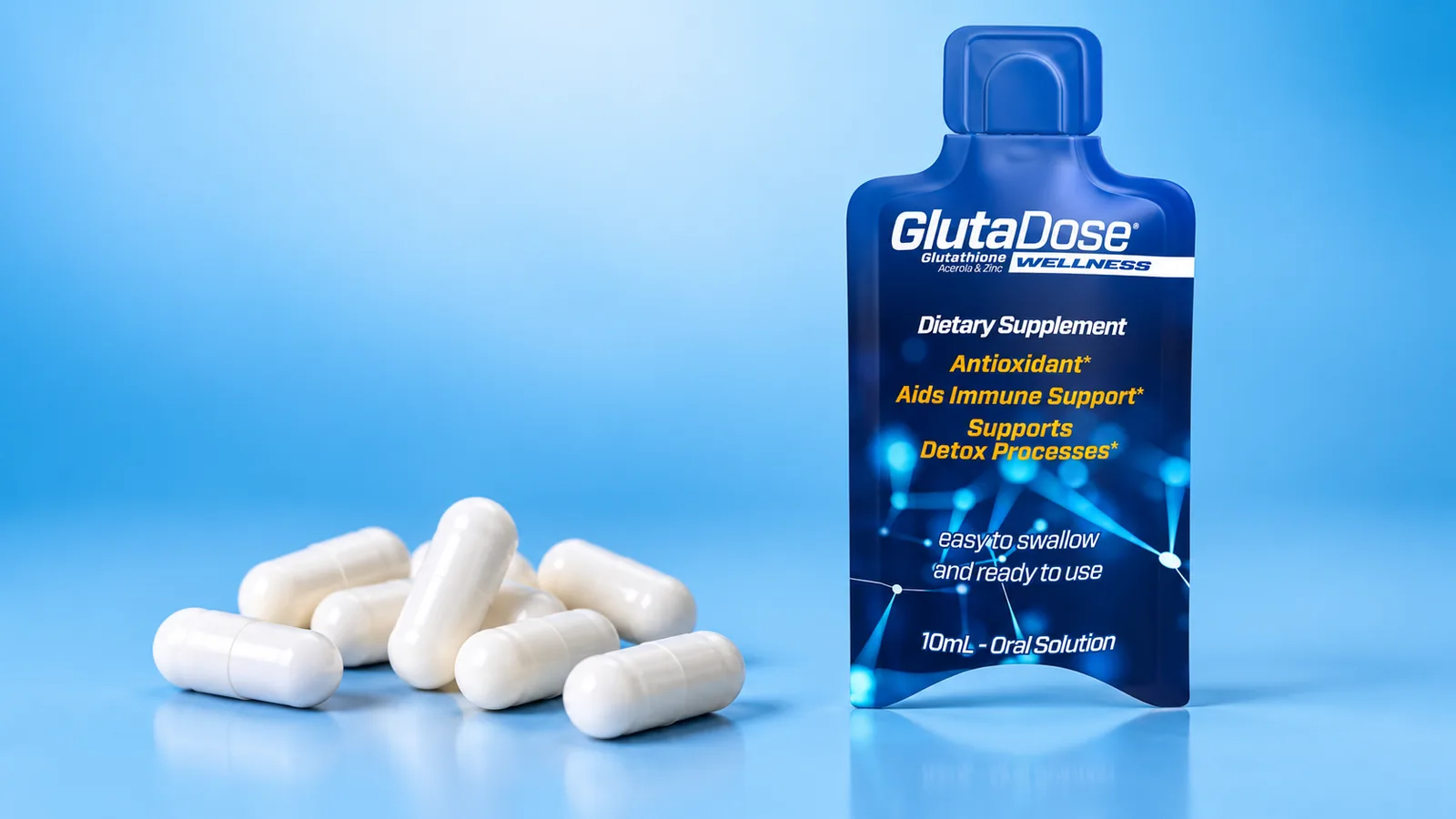
If NAC means handing your body building blocks, GlutaDose® Wellness means handing it the finished piece, through the sublingual route, the one that outperformed capsules in the comparative study. In addition, one dose brings together what science puts to work as a team:
- 480 mg of reduced glutathione, within a 780 mg proprietary blend with acerola extract, a natural source of vitamin C.
- 10 mg of zinc.
- Sublingual liquid format: hold it under your tongue for 10 to 15 seconds, then swallow.
- One exact dose every morning, because consistency is key in every study. No sugar, no pills to swallow and no powders to mix.
Meanwhile, vitamin C helps restore glutathione to its active form so it can keep working [9]. Made in the USA in an FDA-registered, GMP-certified facility.
† Marketed as Mucomyst® (acetylcysteine) as a mucolytic.
Which One Fits Your Profile?
NAC may fit you if:
- You prefer capsules and don’t mind taking several a day.
- You’d rather supply only cysteine and combine it yourself with other ingredients, such as glycine.
GlutaDose® Wellness fits you if:
- You want the complete glutathione molecule, without relying only on your body to assemble it.
- You prefer the sublingual route, the one that outperformed glutathione capsules in the comparative study.
- You’re looking for glutathione, vitamin C and zinc in one 15-second step, with no pills.
- You need a simple routine you can keep every morning, at home or on the go.
Frequently Asked Questions
Which is better, NAC or glutathione?
It depends on what you’re looking for. On one hand, NAC supplies a single building block and reaches the blood intact at 4% to 9%. On the other, reduced glutathione arrives already formed, and its sublingual form outperformed glutathione capsules in a comparative study. Therefore, if you want the complete molecule, sublingual is the format with the most support.
What’s the difference between NAC and glutathione?
Simply put, NAC is a stable form of the amino acid cysteine, one of glutathione’s three building blocks. Glutathione, in contrast, is the complete molecule, made of glutamate, cysteine and glycine.
Is NAC legal as a supplement in the U.S.?
Since 2022, the FDA has allowed its sale as a supplement while it resolves the issue. Then, in November 2026, it proposed a rule to formally recognize NAC as a dietary supplement ingredient. However, the rule is not final yet.
Can I take NAC and glutathione together?
No studies have evaluated that combination with sublingual glutathione. So if you take medications or have a health condition, talk to your doctor before combining supplements.
Does GlutaDose® Wellness break a fast?
Because it’s sugar-free, GlutaDose® Wellness fits easily into a fasted morning routine. Even so, if you follow a strict fasting protocol, check the nutrition information on the label.
The Bottom Line
Both aim for the same thing: giving your cells one of their key antioxidant defenses. While NAC hands your body a building block, reduced glutathione hands it the finished piece. Ultimately, science suggests that if you choose glutathione, how you take it matters, and the sublingual route is the most promising today.
So if you’ve decided you want the finished piece, the next step takes 15 seconds.
Scientific References
None of these studies used GlutaDose®. They were conducted with glutathione, NAC, their precursors or related nutrients.
Absorption and Comparison
- Schmitt B, Vicenzi M, Garrel C, Denis FM. Effects of N-acetylcysteine, oral glutathione (GSH) and a novel sublingual form of GSH on oxidative stress markers: a comparative crossover study. Redox Biol. 2015;6:198–205. Randomized crossover study, n = 20, 3 weeks per product (NAC 200 mg/day; oral or sublingual glutathione 450 mg/day). Limitation: no placebo; sublingual product supplied by its manufacturer, with which one author is affiliated. PMC4536296
- Richie JP Jr, et al. Randomized controlled trial of oral glutathione supplementation on body stores of glutathione. Eur J Nutr. 2015;54(2):251–263. Randomized trial, n = 54, 6 months. PubMed 24791752
- Allen J, Bradley RD. Effects of oral glutathione supplementation on systemic oxidative stress biomarkers in human volunteers. J Altern Complement Med. 2011;17(9):827–833. Randomized trial, n = 40, 4 weeks. Limitation: short duration. DOI
- Olsson B, et al. Pharmacokinetics and bioavailability of reduced and oxidized N-acetylcysteine. Eur J Clin Pharmacol. 1988;34(1):77–82. Crossover pharmacokinetic study, n = 6. Limitation: very small sample. DOI
GlyNAC and Precursors
- Kumar P, et al. Supplementing glycine and N-acetylcysteine (GlyNAC) in older adults improves glutathione deficiency, oxidative stress, mitochondrial dysfunction, inflammation, physical function, and aging hallmarks: a randomized clinical trial. J Gerontol A Biol Sci Med Sci. 2023;78(1):75–89. Double-blind randomized trial, n = 24 older adults (+12 young reference adults), 16 weeks. Limitation: small sample, relatively healthy participants. DOI
- Sekhar RV, et al. Glutathione synthesis is diminished in patients with uncontrolled diabetes and restored by dietary supplementation with cysteine and glycine. Diabetes Care. 2011;34(1):162–167. Non-randomized study, n = 12 + 12 controls, 14 days. Limitation: no placebo. PMC3005481
Regulation and Vitamin C
- U.S. Food and Drug Administration. Final guidance: Policy regarding N-acetyl-L-cysteine. August 2022. FDA
- FDA. Proposed rule: Rulemaking to provide that N-acetyl-L-cysteine is not excluded from the dietary supplement definition. Federal Register, November 2026. Docket FDA-2025-N-2699. Federal Register
- Meister A. Glutathione-ascorbic acid antioxidant system in animals. J Biol Chem. 1994;269(13):9397–9400. Review. PubMed 8144521
Required Disclaimers
These statements have not been evaluated by the Food and Drug Administration. This product is not intended to diagnose, treat, cure, or prevent any disease.
Not recommended during pregnancy or breastfeeding. Consult your doctor before use if you have an autoimmune condition, have had a transplant, have an acute infection, or take prescription medications, including immunosuppressants. Discontinue use 1 week before any surgery. This article is for informational purposes only and is not a substitute for medical advice.