
Sublingual glutathione or liposomal glutathione? If you have shopped for glutathione, you have seen both formats everywhere.
Updated November 2026
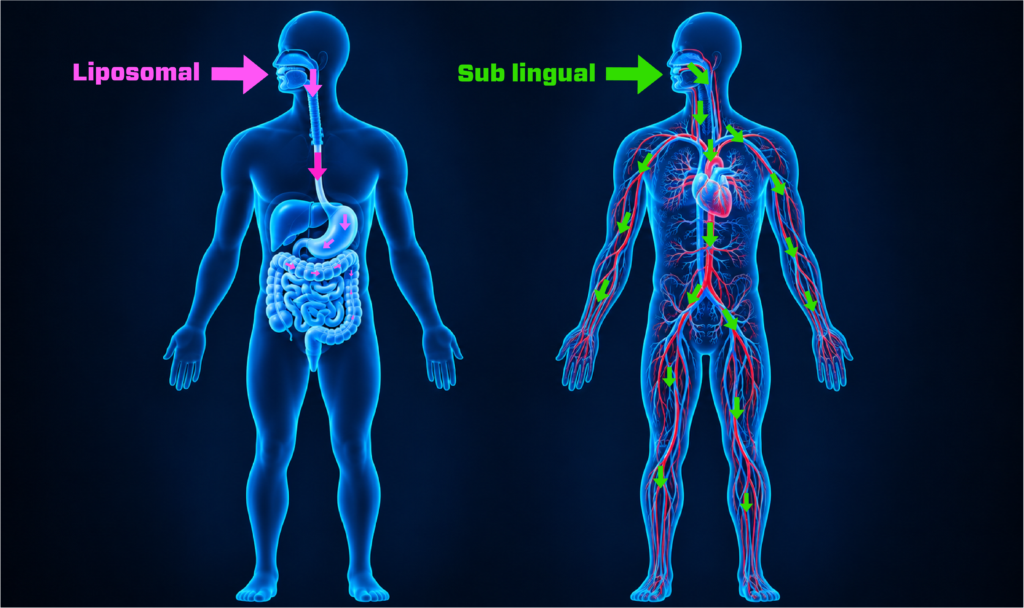
Both promise better absorption than a regular capsule. But they work in very different ways. Here is what each one does, what human studies show, and which one comes out ahead.
Key takeaways
- For years, scientists doubted that glutathione could survive digestion. Several formats can now raise the body’s levels.
- Liposomal glutathione is wrapped in tiny fat bubbles that protect it. You still swallow it, and it still goes through the digestive tract.
- Sublingual glutathione is absorbed under the tongue and skips the stomach entirely.
- In a head-to-head study, a sublingual form raised blood glutathione more than standard oral glutathione.
- Sublingual is the only one of the two that skips digestion completely and beat standard oral glutathione head to head. That makes it our pick.
Why the format matters
Glutathione is the main antioxidant your body makes. When you swallow it, enzymes in the gut can break part of it down before it reaches the blood. That is why manufacturers developed formats designed to protect it or to skip digestion. To learn what glutathione does in your body, read Glutathione Benefits.
How liposomal glutathione works
Liposomes are microscopic bubbles made of fats similar to those in your cell membranes. They wrap the glutathione to protect it on its way through the stomach and intestine.
What the research shows: in a one-month pilot study at Penn State, 12 adults took liposomal glutathione daily. Their blood levels rose within one week and peaked at about 40% above baseline at two weeks (Sinha et al., 2018). It was a small study without a comparison group.
How sublingual glutathione works
Under your tongue there is a dense network of small blood vessels. A liquid held there for a few seconds can be absorbed directly into the bloodstream, without passing through the stomach or the liver first.
What the research shows: in a crossover study of 20 adults, researchers compared three options for three weeks each: N-acetylcysteine, standard oral glutathione, and a sublingual glutathione. The sublingual form produced higher blood glutathione levels and a better antioxidant balance than the other two (Schmitt et al., 2015). Another study of an in-mouth (orobuccal) formulation also found better absorption than a standard oral form (Buonocore et al., 2016).
And regular capsules?
They can work too, with patience. In a six-month, placebo-controlled trial at Penn State, 54 adults taking oral glutathione raised their body stores by up to 35% at the higher dose (Richie et al., 2015). The largest gains took months, and levels dropped back after people stopped.
Side by side
| Sublingual | Liposomal | Capsules | |
|---|---|---|---|
| How it is taken | Under the tongue, 10–15 seconds | Swallowed | Swallowed |
| Goes through digestion | No, absorbed in the mouth | Yes, it still has to survive the gut | Yes |
| Strongest human evidence | Randomized crossover: beat oral glutathione head to head | Small pilot study, no comparison group | 6-month placebo-controlled trial, gains took months |
| With slow digestion or nausea (common with GLP-1) | Not affected: no stomach needed | Depends on the stomach | Depends on the stomach |
| Daily routine | 15 seconds, nothing to swallow | Measure and swallow | Swallow pills |
Our verdict: sublingual comes out ahead
Liposomal glutathione was a real step forward over capsules. But it still asks your stomach to do the work: it has to be swallowed, survive stomach acid and intestinal enzymes, and then be absorbed in the gut. Sublingual skips all of that. Here are three reasons it comes out ahead:
- It skips digestion completely. Glutathione is absorbed through the blood vessels under your tongue, the most direct route to your bloodstream short of a needle.
- It has the stronger evidence. The sublingual study was a randomized crossover: every participant tried each option, and sublingual came out on top. The liposomal study was a small pilot with no comparison group.
- It works when your stomach does not. Slow digestion, nausea, or a sensitive stomach do not get in the way, because the stomach is not involved.
If you take a GLP-1 medication, such as semaglutide or tirzepatide, the choice is even clearer. These medications slow stomach emptying, and nausea is one of their most common side effects. Anything you swallow, liposomal included, has to wait in a slower stomach. Sublingual glutathione does not. Rapid weight loss also adds work for the liver; we explain why in Glutathione and Your Liver.
How does GlutaDose® Wellness fit in?
GlutaDose® Wellness is a sublingual liquid glutathione in single-dose vials. Each vial combines glutathione, vitamin C from acerola, and zinc:
- Helps maintain healthy immune function*
- Supports healthy cell function*
- Increases body energy, reducing fatigue*
Take one vial every morning on an empty stomach and hold it under your tongue for 10 to 15 seconds before swallowing. If you take medication, talk to your doctor before adding any supplement.
Frequently asked questions
Is sublingual glutathione better than liposomal?
For most people, yes. Sublingual skips digestion entirely, and it is the only one of the two that beat standard oral glutathione in a head-to-head study. A trial comparing the two directly has not been done yet, but both the route and the evidence favor sublingual.
How long should I hold sublingual glutathione under my tongue?
About 10 to 15 seconds, then swallow. Avoid eating or drinking right before.
When is the best time to take it?
In the morning, on an empty stomach, as part of a daily routine. Consistency matters more than timing: levels drop when you stop.
Can I take glutathione with GLP-1 medications?
This combination has not been studied specifically. Always tell your doctor about any supplement you add.
Conclusion
Liposomal glutathione protects it through digestion. Sublingual glutathione skips digestion altogether, and that difference matters. Sublingual takes the most direct route to your bloodstream without a needle, it has the stronger head-to-head evidence, and it does not depend on your stomach. Our verdict: sublingual comes out ahead, especially if you want an easy daily routine, have a sensitive stomach, or take a GLP-1 medication.
Scientific references
- Schmitt B, Vicenzi M, Garrel C, Denis FM. “Effects of N-acetylcysteine, oral glutathione (GSH) and a novel sublingual form of GSH on oxidative stress markers: A comparative crossover study.” Redox Biology, 2015; 6:198–205.
- Sinha R et al. “Oral supplementation with liposomal glutathione elevates body stores of glutathione and markers of immune function.” European Journal of Clinical Nutrition, 2018; 72(1):105–111. PubMed.
- Richie JP Jr et al. “Randomized controlled trial of oral glutathione supplementation on body stores of glutathione.” European Journal of Nutrition, 2015; 54(2):251–263. PubMed.
- Buonocore D et al. “Bioavailability Study of an Innovative Orobuccal Formulation of Glutathione.” Oxidative Medicine and Cellular Longevity, 2016. PMC4663342.
*These statements have not been evaluated by the Food and Drug Administration. This product is not intended to diagnose, treat, cure, or prevent any disease.